

The report said the import cover has gone down to seven months, last seen in 1998 and hence, RBI will focus on recouping the reserves.

India spends significantly less on defence than could be expected from a country that faces simultaneous armed threats from two hostile neighbours -- China and Pakistan.
The government expects non-resident Indians to pump in about $500 billion into the burgeoning forex reserves of the country in the next 10 years, making them the single largest source of foreign receipts.
The government will move fast towards a more liberal forex regime in the backdrop of a record foreign exchange reserves of 68 billion dollar and fresh inflow of $500 million a week, Finance Minister Jaswant Singh said.

Emerging nations have discussed delinking the quotas from the governance reforms to facilitate its passage.
The government on Friday warned that fiscal deficit was hindering growth despite strong economic situation prevailing now with high forex reserves, surplus food-grains and low inflation, while asking regulators to plug the loopholes to make the marke

The Enforcement Directorate (ED) on Friday said it has issued show-cause notices to the Indian arm of Chinese mobile phone manufacturer Xiaomi, its chief financial officer and director Sameer B Rao, former managing director Manu Kumar Jain and three foreign banks for alleged violations of the foreign exchange law to the tune of more than Rs 5,551 crore.

India's current account slipped into a deficit of $9.6 billion or 1.3 per cent of GDP in the September quarter, the Reserve Bank said on Friday. The current account, which records the value of exports and imports of both goods and services along with international transfers of capital, was in a surplus mode both in the quarter-ago and year-ago periods. India's current account surplus had stood at $6.6 billion or 0.9 per cent of GDP in the April-June 2021 quarter, while in the year-ago period (Q2FY22), the surplus had stood at $15.3 billion or 2.4 per cent of the GDP, the data said.
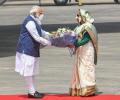
Bangladesh Prime Minister Sheikh Hasina is expected to travel to India on September 5 on a three-day official visit during which defence cooperation and regional stability are likely to be the focus of her talks with Indian counterpart Narendra Modi, an official said on Monday.
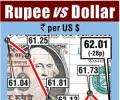
Foreign brokerage HSBC has said it expects the rupee to trade at 60-levels by December against the dollar even though risks on the domestic unit from both external and domestic fronts have increased.

Economist Jayati Ghosh noted that the word 'freebies' indicates the class position of those who use it.
As part of efforts to boost Indo-US trade ties, a high-level American delegation led by president and CEO of US Chamber of Commerce Thomas J Donahue will visit India on Tuesday for a meeting with the Confederation of Indian Industry.\n\n\n\n
Forex inflows may slow down and banks may be deprived of cheap funds if the government accepts Reserve Bank of India's suggestion to tax non-resident Indian deposits, bankers warned on Wednesday.
The economic fundamentals were strong enough to ensure 6-6.5 per cent growth in GDP during 2003-04, while fiscal deficit will be under control, D C Gupta, finance secretary said on Friday.
Echoing Finance Minister Jaswant Singh's projection of a "significant" economic growth this year, economists on Friday pegged the GDP growth at 6-6.5 per cent but cautioned the Centre on increasing debt and fiscal deficit.

'India's sizeable forex reserves should help stem a possible fall in our currency.'

'When the gold price rises rapidly, India's physical gold market remains on standby.'
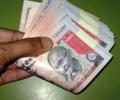
The CAD was brought under control in 2013-14 after government imposed restrictions on import of gold. Following, this in 2014, certain restrictions were withdrawn.

Gold reserves increased $1.54 billion to $32.68 billion in the reporting week.

Overseas investors have pulled out a net Rs 1,14,855.97 crore from the Indian markets in the current year so far, amid heightened geopolitical tensions and inflation concerns. Foreign portfolio investors have sold domestic equities worth Rs 48,261.65 crore so far this month, taking the year-to-date tally this year to a massive Rs 114,855.97 crore, according to depositories data. The exodus of foreign investors was largely owing to inflationary pressures and deepening global macroeconomic conditions following the Russia-Ukraine war, experts said.

ED and Directorate of Revenue Intelligence have detected a significant increase in the outflow of Indian money, specifically into four countries --Thailand, Dubai, Singapore and Hong Kong.

Brent crude prices fell to $57 a barrel on Monday from $62 a barrel.
Since end-May there has been volatility in the foreign exchange market.

'She delivers on promises, especially on security issues which is a core concern for India.'

For the banking system a new cycle starts in FY2024. It's fraught with fresh challenges on asset quality and profitability, warns Tamal Bandyopadhyay.

Exchange-traded currency derivatives volumes are likely to drop in view of new Reserve Bank of India (RBI) rules, casting a cloud over further participation of retail investors and proprietary traders. There are concerns that existing positions without any underlying exposure will need to be liquidated. Also, weighed down by dollar demand from local oil companies and weakness in its Asian peers, the rupee on Wednesday (April 3) ended at a new closing low of 83.44 versus the US currency.

Global rating agency S&P on Tuesday said even though the US and the Euro zone are headed to recession, India is unlikely to face the impact given the "not so coupled" nature of its economy with the global economy. "Indian economy is a lot decoupled from the global economy than we normally think of, given its large domestic demand, even though you (India) are a net importer of energy. "But you have enough forex reserves on one hand and your companies have managed to maintain healthy balance sheets," Paul F Gruenwald, S&P global chief economist and managing director, told reporters in Mumbai.

Nepal's decision to ban the import of non-essential items amid depleting forex reserves may hit Indian exports. The country's central bank - Nepal Rastra Bank - last week instructed commercial banks not to open letters of credit (LCs) for importing non-essential items. This is to prevent further decline of the country's foreign exchange reserves. However, it has not issued any formal communication yet.

Caution ahead of key consumer inflation data in the day also weighed.

The benchmark Indian crude oil basket is now estimated to average $77.88 a barrel for FY19, compared to the government's earlier estimate of $65 a barrel for the year and $56.39 for FY18

The report, however, said a sustained weakness in USD against the emerging market forex remains a key risk to this view.
The RBI is widely expected to raise its key repo rate by 25 basis points to 8.00 per cent on Wednesday, its third such hike in four months after recent data showed both wholesale and retail inflation at multi-month highs.

'Valuations are very attractive, and most companies are cash-rich with strong dividend yields.'
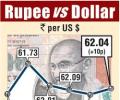
The currency's relatively stable performance even as the US announced tapering showed India's better preparedness to deal with any fallout of such foreign fund outflows.
'A strong foreign exchange reserve is the best safety net against global spillovers.'
